



What it costs
Is Emirates Business Class Worth the Money From the UK? The Honest Cost Breakdown
Is Emirates business class worth the money from the UK? Yes on eight-hour-plus sectors under £2,500 return on an A380. The honest cost breakdown, the Skywards maths, and the rivals to weigh first.
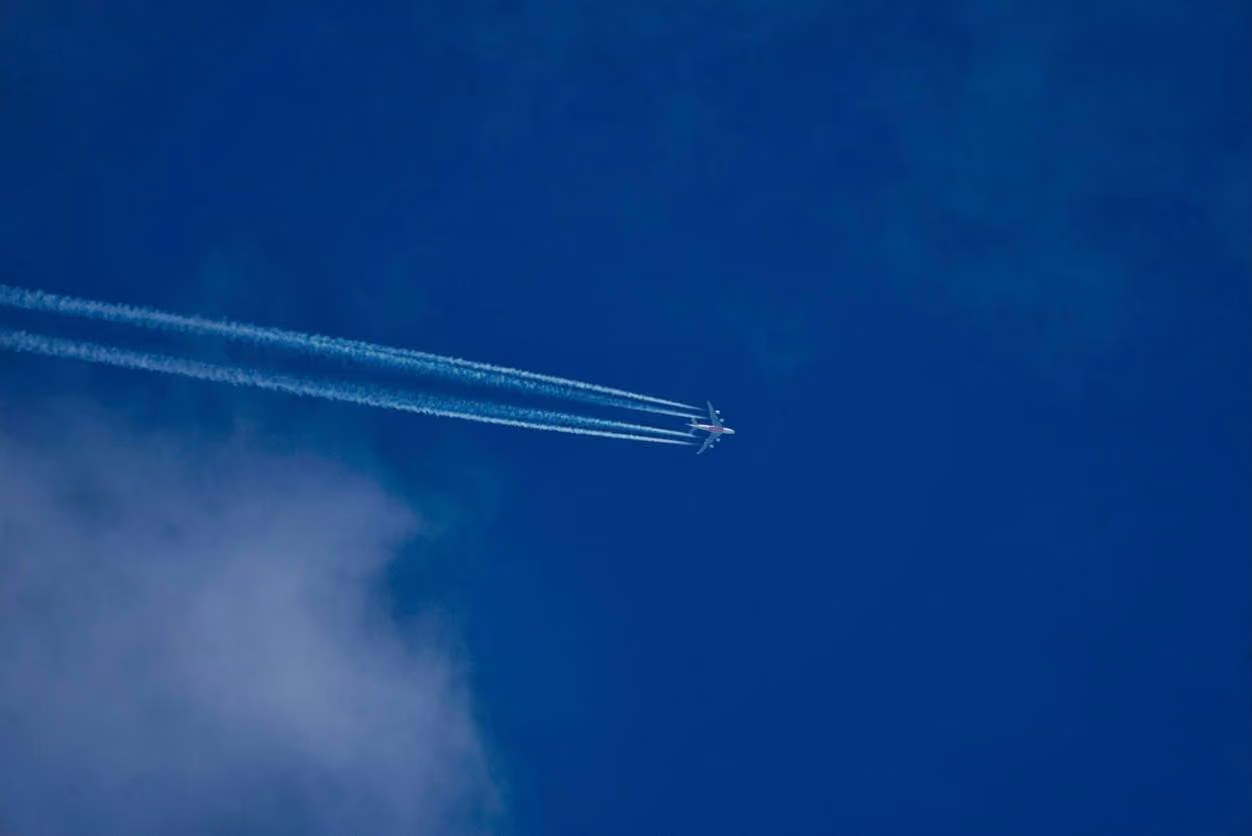
Emirates business class worth the money is a question many UK travellers ask, and the answer is yes on sectors of eight hours or more when the return cash fare sits below £2,500 and you are confirmed on an A380. Above £2,800, Qatar Qsuites and Virgin Upper Class both deserve a hard look before you commit to a ticket on Emirates.com.
Return fares from Heathrow to Dubai in business class currently range from £1,600 in January to around £2,800 in August, with Manchester departures running £100 to £200 cheaper on equivalent dates. That fare bundles two checked bags at 32 kg each, a complimentary chauffeur service within roughly 75 km of the airport, and access to the Emirates Lounge in Heathrow Terminal 3, which serves hot food and a Champagne list considerably better than most airport restaurants manage. Economy on the same route rarely drops below £450 return, so the premium is real, though not as dramatic as the cabin photographs suggest.
Is Emirates business class worth the money?
Whether Emirates business class is worth the money turns on three variables: flight length, fare price and whether the A380 is operating on your specific date. On a seven-hour overnight from Heathrow to Dubai, a fully flat 76-inch bed is the thing you are genuinely paying for. Arriving rested at 06:00 local versus arriving creased is not a marginal upgrade. On a 14-hour sector to Sydney or Bangkok, where cash fares can exceed £4,000 return, the case is close to self-evident.
Skywards miles change the calculation substantially. A return business class flight from Heathrow to Dubai typically costs 90,000 to 100,000 Skywards miles plus around £600 in taxes and surcharges. The UK Civil Aviation Authority notes that carrier-imposed surcharges are a mandatory cash element regardless of how the base fare is redeemed, so that £600 is unavoidable. Valued at a conservative 0.8p per mile, 90,000 points equate to roughly £720 in notional redemption value, making the total outlay around £1,320, excellent value against a £2,000 cash fare. On longer hauls to Sydney, where cash fares exceed £4,000, the absolute saving widens even if the pence-per-mile rate holds flat.
One detail most cabin reviews skip: the ground package does not transfer to a last-minute gate upgrade. Chauffeur drive, extra baggage allowance and lounge access attach to a business class ticket purchased in advance, not to a discounted upgrade token bought at check-in. If the ground package is part of why the fare makes financial sense, book the full ticket rather than gambling on availability at the gate.
Some UK-licensed travel agents bundle chauffeur and lounge access into package fares that undercut Emirates.com by £200 to £300. ABTA package booking guidance confirms that ATOL protection applies to package arrangements through licensed agents, adding a layer of financial cover that booking directly does not automatically provide. On a £2,400 fare, the agent route can land at roughly £2,150 all-in, a difference large enough to cover the transfer at the other end.
The threshold in plain terms: under £2,000 return for a sector of eight hours or more, Emirates business class is difficult to argue against. Between £2,000 and £2,800 it remains defensible when the ground package is treated as a cash equivalent rather than a marketing flourish. A chauffeur from a Heathrow-area postcode costs roughly £80 to £120 at commercial transfer rates; a comparable airport lounge day pass runs £30 to £50. Those ancillaries add up to between £200 and £250 per return trip, which meaningfully narrows the apparent premium. Above £2,800, the comparison in the final section below applies.
It is also worth separating the question of whether Emirates business class is worth the money from whether it is the best product at that price. It is not always the best, but it is frequently the most consistent, which is a different and often more commercially relevant quality when you are buying a ticket six months out and cannot guarantee which hardware a rival will field on the day.
For context on how this stacks up further up the cabin ladder, the First Class vs Business Class long-haul breakdown covers when the step up to a full suite makes financial sense on routes where Emirates operates both products.
Is Emirates business class better on A380 or 777?
The A380 is the stronger aircraft on almost every UK departure, though the margin depends on which 777 variant operates your specific flight. This distinction is worth two minutes of research before you book, because the same route can run both aircraft types on different days of the week, and the product you receive differs substantially between them.
Emirates A380 business class sits on the upper deck in a 1-2-1 herringbone configuration, meaning every seat has direct aisle access without disturbing a neighbour at 2am. The flat bed measures approximately 76 inches long and 23 inches wide. Upper-deck positioning places the cabin above the underwing engines, making it noticeably quieter than the main deck on any widebody. The standout feature, available nowhere else in the Emirates fleet, is the onboard bar lounge at the rear of the upper deck: a standing bar with seating for roughly eight passengers. On the evening EK003 departure from Heathrow to Dubai, that bar is a material part of the overnight experience rather than a novelty. The business class monitor on the A380 runs to 23 inches; the older 777 business class tops out at around 17 inches, a difference that registers clearly in a window seat where you are already sitting at a slight angle to the panel.
The 777 picture is more complicated. On the older 777-300ER variant, which still operates several UK rotations, the layout is a 2-2-2 angled configuration, not fully flat. Middle seats lack direct aisle access, and the bed angle on a seven-hour overnight is noticeably less comfortable than anything on the A380 upper deck. Emirates has retrofitted some 777s with its Business Class Studio product: a 1-2-1 fully flat layout with a 22-inch wide seat, a personal mini-bar stocked per passenger and a closing door. The Studio is genuinely competitive hardware. The catch is that it is mainly deployed on routes to the United States and Australia rather than routinely on UK-to-Dubai services, so confirming equipment before booking matters as much on Emirates as it does on Qatar.
Aircraft-type checking is straightforward. The IATA equipment code A388 denotes the A380; 77W denotes the 777-300ER. Both are visible on the seat-map page when booking through Emirates.com or on any flight-search tool that displays equipment codes. Shifting your departure date by a single day can be enough to switch aircraft if the cabin configuration matters, and on an overnight sector it genuinely does. Midweek departures on the Dubai route more frequently show A380 equipment than weekend services, though this varies by season and scheduling cycle.
On the standard 777 in the 2-2-2 layout, the privacy of the Studio simply does not exist, and Emirates business class is worth considerably less money in that configuration. A rough guide: on the 2-2-2 angled product, the fare should sit no higher than £1,800 return to Heathrow-Dubai to remain competitive with premium economy alternatives on the same sector. That is not a fringe scenario, several winter rotations still use the older layout, and passengers who did not check the equipment code before booking are regularly surprised.
For a head-to-head look at how the A380 upper deck compares to rival hardware in detail, the Emirates vs Singapore Airlines business class comparison covers seat specs, service differences and which routes make each carrier the stronger choice.
Which seats to avoid on Emirates A380 business class?
The upper-deck business cabin on a three-class A380 runs to roughly 76 seats in a 1-2-1 herringbone layout. Most rows are genuinely good. A specific handful are not, and knowing which saves you a seven-hour overnight in the wrong position.
Centre column pairs are the most divisive. Rows 11D/G and 12D/G place two strangers directly adjacent with only a shared console between them and no hard divider. Solo travellers consistently report these as the least private seats in the cabin. Couples who want to sit together often book them deliberately, which is the one scenario where a centre pair makes practical sense. For solo bookings, any window seat in mid-cabin rows is the correct choice.
The bulkhead row at the very front of the upper-deck business section is row 8. Because no seat sits ahead, the foot of your flat bed meets the bulkhead wall rather than sliding under the adjacent seat. Emirates lists the flat-bed length at 76 inches across the cabin, but the bulkhead restricts usable stretch in practice, passengers above six feet report this most acutely on the seven-hour Heathrow-to-Dubai overnight. Seats 8A and 8K, the outermost window positions in that bulkhead row, carry a secondary problem: proximity to the forward lavatories on the upper deck. Foot traffic is light, but the corridor effect is present in a way mid-cabin rows avoid entirely.
Row 14, at the rear of the upper-deck business cabin in the three-class configuration, sits directly adjacent to the stairwell and galley. On a daytime sector this is manageable. On the return red-eye from Dubai to Heathrow, which departs around 03:00 local, galley noise and movement from passengers heading to the onboard bar makes row 14 a poor choice for light sleepers. That bar generates a steady trickle of movement past the rearmost rows for the first three or four hours of any overnight eastbound leg.
The mid-cabin window seats, specifically 10A, 10K, 12A and 12K, are the ones most frequently cited by frequent flyers as the best available. Full bed length, a window to rest against, and enough distance from both galley and lavatories to sleep undisturbed on the overnight eastbound leg. These are the seats that make Emirates business class worth the money in the first place, and they fill quickly on popular departure dates.
One caveat that matters: Emirates operates both a two-class A380 variant with a larger business cabin extending to around row 22, and a three-class variant where business compresses into roughly rows 8 to 15. The galley-noise problem shifts depending on which variant operates your route. Row 14 in the three-class cabin is the last row before the galley; in the two-class variant you have considerably more buffer behind you. Two-class A380s most commonly appear on high-demand leisure routes where Emirates wants maximum business class inventory, if your flight shows more than 15 rows of business class on the upper deck, you are almost certainly on the two-class configuration and rows 18A and 18K become the equivalent sweet spot: mid-cabin, window, away from galley activity at both ends. Check the Emirates manage-booking seat map for your specific flight before selecting, rather than relying on general seat-map guides that do not distinguish between variants.
Which airline has the nicest business class from the UK?
Qatar Airways Qsuites is the most consistently rated business class product currently flying from Heathrow, with six consecutive Skytrax World's Best Business Class awards as of 2024. Emirates ranks second in most independent assessments, ahead of Singapore Airlines and Virgin Atlantic on overall product, though the gap narrows sharply depending on aircraft and route. Knowing where Emirates business class sits against these rivals is the clearest way to judge whether it is worth the money at a given fare level.
Four carriers genuinely compete from Heathrow for a UK traveller making this decision: Qatar, Emirates, Singapore Airlines and Virgin Atlantic. Each wins on a different dimension.
Qatar Airways Qsuites are fitted to Boeing 777s and selected A350s. Each suite has a closing door, a 79-inch flat bed 21 inches wide, and a double-bed configuration for travelling couples that no other mass-market cabin currently matches. Heathrow-to-Doha return fares sit around £2,800 to £3,500 in 2025, broadly comparable to Emirates A380 business class at peak pricing. The Al Mourjan lounge at Doha's Hamad International is larger and quieter than the Emirates lounge in Terminal 3. On hardware alone, Qatar wins. The non-negotiable catch: Qsuites are not fitted across the entire Qatar fleet, so confirming the suite is on your specific aircraft before paying is essential, exactly the same discipline required when checking Emirates equipment codes.
Singapore Airlines business class on the A350 and 777 uses a 1-2-1 herringbone layout with a 23-inch wide seat and a 78-inch bed. Return fares from Heathrow to Singapore typically run £3,200 to £4,500, higher than either Qatar or Emirates on equivalent distances. For routes continuing to Sydney or Tokyo, the connecting-fare logic often makes Singapore hard to beat on total value despite the higher base price, particularly given the carrier's consistent Skytrax service ratings. Meal quality and crew attentiveness are the areas where Singapore most clearly edges Emirates in side-by-side reviews, and the gap is not marginal on a 13-hour sector.
Virgin Atlantic Upper Class on the A350, introduced in 2022, offers a closing door and a 1-1-1 layout in the front cabin, with a bed length of 82 inches, longer than the Emirates A380 configuration. Return fares from Heathrow to New York JFK typically start around £2,200, undercutting Emirates on the equivalent transatlantic routing. The Clubhouse at Heathrow Terminal 3 is smaller than the Emirates lounge but food and bar quality are strong. For transatlantic routes specifically, Virgin is the more financially credible rival, and the closing door matters more on a night sector than the Emirates bar lounge, which is primarily a daytime benefit on westbound flights.
Emirates' practical advantage over all three is scale and consistency. More than 100 A380s in service means the flagship product, bar lounge, 23-inch screen and 76-inch flat bed, is not a lottery on which aircraft you draw on a given day. Qatar's Qsuites cover only a portion of their 777 fleet. Singapore's best hardware is confined to specific routes. Emirates also includes chauffeur drive in the business class fare on UK routes, a benefit none of the three rivals offer as standard at equivalent fares, and that ground package is worth between £200 and £250 per return trip in real cash terms.
Where Emirates loses ground is the absence of a closing door. The suite privacy Qatar delivers is a materially different sleep environment on a 14-hour overnight to Australia, not just a marketing distinction. On a seven-hour Heathrow-to-Dubai sector that gap matters considerably less, which is precisely why Emirates business class is worth the money on shorter long-haul but faces stiffer competition once sectors exceed 12 hours and uninterrupted sleep becomes the dominant variable.
The verdict per carrier in plain terms: if hardware privacy matters most, book Qatar and confirm Qsuites are fitted before paying; if service consistency and onward connections to Southeast Asia or Australasia are the priority, Singapore Airlines; if scale, included ground services and a fare under £2,500 return are the deciding factors, Emirates is the financially grounded choice from the UK. UK travellers routing through Dubai to onward destinations should check the FCDO foreign travel advice pages as a standard planning step regardless of which carrier they book.
For a deeper look at when premium cabin hardware justifies a further step up, the guide to what first class adds over business covers the suite, service and price gap on routes where Emirates operates both cabins. And for the stay at the other end, our guide to the best hotels in Dubai covers the full range from beachfront to city centre with current 2025 rate context, the natural next decision once the cabin question is settled.