

Flights
Emirates A380 Business Class, Reviewed: The Upper Deck, the Bar, and What It Costs
Emirates A380 business class from Heathrow, reviewed: the seats to book and avoid, what the bar and flat bed are like, and whether the fare or 75,000 Avios is worth it.
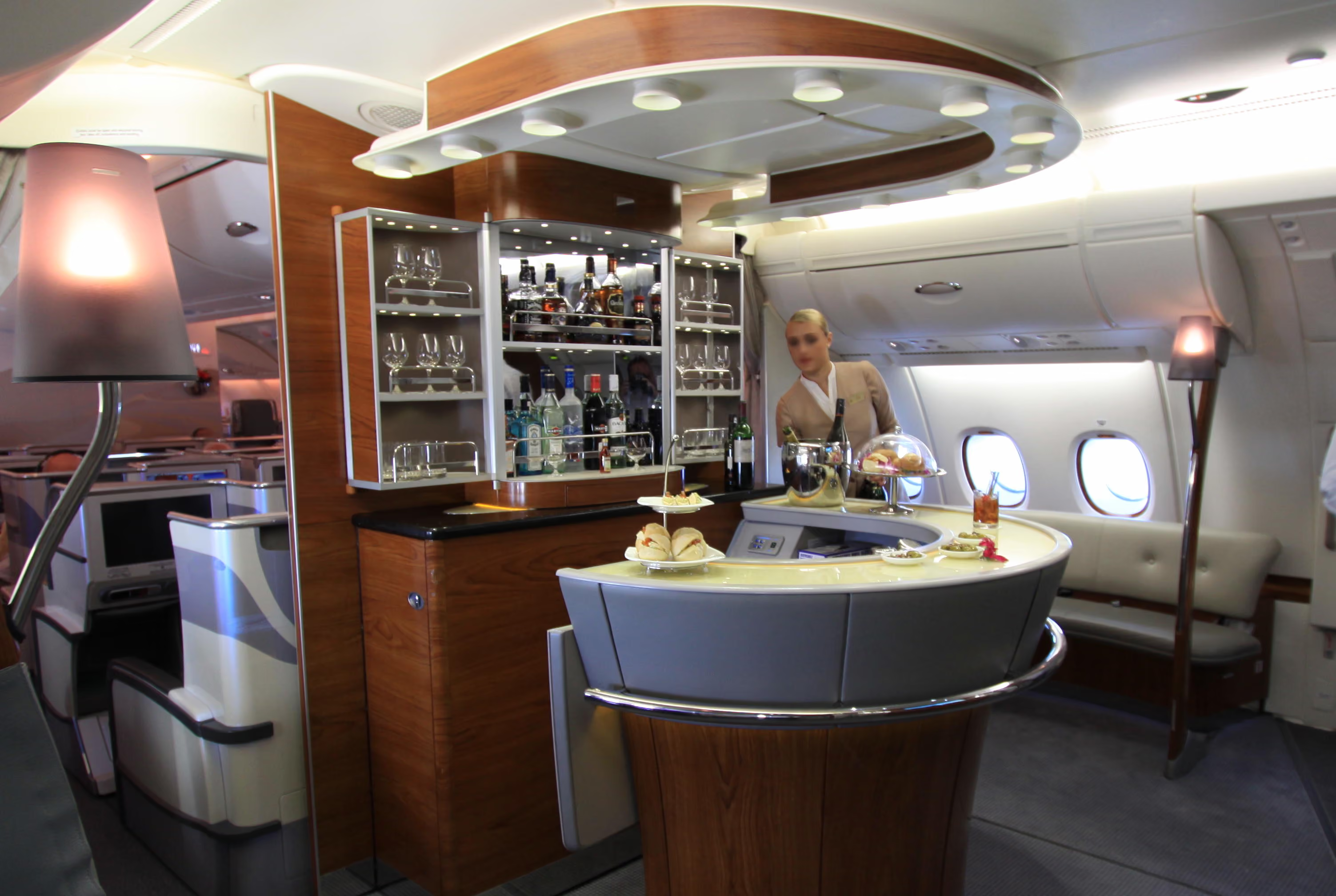
Not every seat in Emirates A380 business class is equally good, and the gap between the best and worst positions is wide enough to determine whether a £2,500 fare or a 75,000-Avios redemption feels justified. The cabin sits on the upper deck in a 1-2-1 herringbone layout across 76 seats, with fully flat beds running 79 to 80 inches, direct aisle access from every position, and an onboard bar that no comparable business class product currently departing Heathrow matches.
The seat shell architecture dates to 2008. Emirates has refurbished many frames since, but the basic structure has not changed. Qatar Airways QSuite and Singapore Airlines' new A350 business class have both moved ahead on privacy and closing-door technology. Emirates counters with a 23-inch IFE screen on refurbished frames, a wine list anchored by Moët & Chandon Brut Imperial NV, and that bar, which seats around 12 passengers and stays open throughout the flight. Whether the product earns its price depends on three variables: route length, cash versus points, and which exact seat you book.
Which seats to avoid on Emirates A380 business class?
Avoid the centre pairs in rows 11 and 12 if you are travelling solo. In Emirates seat-map notation those are the G and K positions: two strangers sit side by side with only a fixed divider between them, and on pre-refurbished frames that divider does not clear shoulder height when the seat converts to a flat bed. On a 14-hour Heathrow-to-Sydney sector, the proximity is genuinely uncomfortable.
Row 18, the last row of the cabin on most configurations, sits directly in front of the rear galley. Crew movement, light spill during service and the steady foot traffic of passengers walking to the onboard bar make this the noisiest section of the upper deck on overnight flights. On a four-hour afternoon sector it barely registers. On an EK003 red-eye departing Heathrow at 21:30, it matters considerably.
Row 11 carries a separate problem. It sits directly behind the first-class partition, which sounds appealing for legroom but means the tray table and IFE screen stow in the armrest rather than the seatback ahead. Both become slightly awkward at meal service. The footwell also narrows at the base because of the partition structure, so bags cannot be placed in front of you during take-off and landing, and crew will ask you to move them every time.
Seats 16A and 16K, the rear window positions on each side, pick up residual noise from the staircase leading up to the bar area. The UK Civil Aviation Authority's passenger guidance makes clear that airlines can substitute aircraft types without notice, so paying a seat-selection fee on the assumption of a specific interior configuration is a gamble. Emirates has charged up to £50 per seat at certain booking windows for preferred positions; spending that on a galley-adjacent or centre-pair seat in rows 17 or 18 is straightforwardly poor value.
Seat maps release significantly at online check-in, which opens 48 hours before departure. If the window singles in rows 12 to 15 are showing as taken at the time of booking, waiting for the check-in window is often the better strategy than paying to secure a suboptimal position. The centre pairs in rows 14 and 15 on refurbished frames are a reasonable fallback for couples because the divider mechanism on those rows lowers fully, but solo travellers should hold out for a single.
One further row worth flagging: seats in row 13 on some configurations sit directly above the wing root, which produces a low-frequency vibration that is more perceptible on older frames than newer ones. It rarely disturbs sleep on a fully flat bed, but passengers who are light sleepers should note it. Rows 14 and 15 sit aft of the wing box and are quieter as a result.
What are the best business class seats on an Emirates A380?
For solo travellers, 11A or 11D are the most consistently praised positions in the cabin: quiet, centred, with the foot of the flat bed angling toward the fuselage wall rather than the aisle. That diagonal orientation creates a sense of enclosure the centre pairs cannot replicate. The bulkhead trade-offs described above apply, but the majority of solo passengers find the compromise worth accepting on a sector over ten hours.
Couples should target rows 10 or 12 in the centre configuration, specifically 10G and 10K or 12G and 12K. On refurbished frames the divider between those seats lowers fully and stows flat, letting two passengers dine across the shared console without the old hard-shell version's partial-drop mechanism creating a visual barrier. Confirming the frame is refurbished before booking is essential here: the pre-refurb divider drops only partway and the seating experience is noticeably more claustrophobic, more like adjacent hotel room beds with a low headboard between them than a genuinely shared space.
Seats 15A and 15K, at the rear of the cabin before the galley rows, can be unexpectedly peaceful. The rear galley on most EK overnight sectors sees less crew preparation traffic than the forward one, and the position avoids both the bulkhead restrictions of row 11 and the bar-staircase noise of rows 16 to 18. Cross-reference your preferred row against SeatGuru's Emirates A380 seat maps, which show galley and lavatory positions by row number for both old and refurbished frame variants, before committing to any seat-selection fee.
One detail most reviews skip: seats on the port side of the cabin (A and D column positions) angle their footwells toward the left fuselage wall, while starboard positions (K column) angle right. On a Heathrow departure heading south-east toward Dubai, the port side typically faces the ground on approach into Terminal 3, which can be relevant if you want natural light in the morning or prefer to sleep without a bright window beside you. Neither is categorically better, but it is worth knowing before you choose.
A note on shoulder width: refurbished A380 business class seats measure approximately 22 to 23 inches at the shoulder, which is meaningfully wider than the 20 to 21 inches on the Boeing 777 variant. Tall passengers and those who find narrow sleeping positions difficult should weight this figure as much as bed length when comparing equipment on a specific route.
Is Emirates business class worth it on an A380?
On a points redemption to a destination ten hours or more from Heathrow, yes. On a cash fare for a seven-hour daytime sector to Dubai, the arithmetic is harder to defend.
Cash fares from London Heathrow to Dubai in Emirates A380 business class run roughly £1,800 to £3,500 return depending on season and booking window, against £400 to £700 in economy. That premium of £1,100 to £2,800 buys a fully flat bed of 79 to 80 inches, lounge access at both ends, and substantially better catering: a four-course meal on the Dine on Demand system, which means you order when you want rather than at a set service window, plus a cheese board and a dessert trolley on sectors over ten hours. For a daytime departure when sleep is not the priority, that gap relative to the fare is genuinely difficult to justify. For a red-eye or a positioning flight before a 14-hour onward leg, the flat bed changes the trip entirely.
Avios through British Airways Executive Club prices the same Heathrow-to-Dubai return at 50,000 to 75,000 Avios plus approximately £350 in taxes and carrier surcharges, subject to availability. American Express Membership Rewards points transfer to Avios at 1:1, and IATA's annual passenger data consistently places the Heathrow-to-Dubai corridor among the highest-volume long-haul routes from the UK, which means both cash competition and points availability are real. A reasonable baseline for business class Avios redemptions sits around 1p to 1.5p per point, placing 75,000 Avios at £750 to £1,125 in real-money terms against a cash fare that can reach £2,500 or beyond in peak December and January. On that basis, a redemption to Sydney or Johannesburg, both sectors above ten hours from the UK, represents defensible value in a way the Dubai run often does not unless the fare is elevated.
The onboard bar is the genuine differentiator from every other business class product currently operating out of Heathrow. It seats around 12 passengers, operates throughout the flight rather than only during service windows, and on long sectors does fill with passengers who wake mid-flight and want somewhere to sit upright with a Hennessy VSOP or a Veuve Clicquot Yellow Label. The bar stocks both, alongside Johnnie Walker Black, a rotating selection of still and sparkling wines by the glass, and a small hot snack menu: cheese toasties and Häagen-Dazs ice cream have appeared on the Dubai-Heathrow return in 2024. No comparable business class product on routes Emirates operates from Heathrow offers an equivalent social space.
Wi-Fi is not included in the fare at any price point. Emirates charges approximately $9.99 for a messaging-only plan and up to $19.99 for full browsing on a single sector, which is an irritant on a product priced above £2,000. Emirates also operates no premium economy cabin on any aircraft, which forces a binary choice between economy and business. On sectors under seven hours, British Airways Club Europe or Virgin Atlantic Upper Class on competing routes cover most of what travellers want at roughly a third of the Emirates business cash fare. Above ten hours, that trade-off reverses sharply and the bar starts earning its keep.
The in-flight entertainment system covers over 6,500 channels on a 23-inch screen on refurbished frames, compared with 17-inch screens on pre-refurb aircraft. The content library is broader than British Airways' Club World on comparable routes and the screen is significantly larger, which matters on a 14-hour sector. The noise-cancelling headsets supplied are the Bose QC35 equivalent on refurbished frames; on older aircraft they are Emirates' own-brand cans, which are noticeably less effective at blocking engine noise on the upper deck.
Pyjamas are supplied on sectors of six hours or more, along with an amenity kit containing Byredo Gypsy Water products on refurbished-frame departures. The bedding is a genuine duvet rather than a blanket, and the mattress topper is approximately two inches thick. Neither detail sounds significant until you are nine hours into a night flight from Heathrow and the difference between a flat surface and a padded one becomes obvious. Qatar Airways QSuite provides a mattress pad of comparable thickness, but the suite door and the greater privacy of the enclosed configuration are harder to replicate without spending upward of £5,000 on the Emirates first-class suite.
Lounge access at Dubai International is through the Emirates Business Class Lounge in Concourse B, which runs to around 5,000 square metres across two floors, with a la carte dining, a spa offering 20-minute treatments on a first-come basis, and a separate cocktail bar. The treatment wait time at peak connection windows, typically 08:00 to 10:00 local Dubai time, can exceed 40 minutes, so arriving at the lounge promptly after landing is worth doing if a treatment is the priority. From Heathrow, business class passengers access the Emirates Lounge in Terminal 3, which is significantly smaller than the Dubai equivalent but offers a hot buffet and a champagne bar open from 06:00 daily.
For a deeper look at when business class genuinely pulls ahead of first on long-haul routes, our piece on First Class vs Business Class Long Haul: Is the Upgrade Worth It? covers the decision in full. A separate piece examining whether Emirates business class is worth the money specifically from the UK is coming soon.
Which Emirates business class plane is considered the best?
The A380 in refurbished configuration on a Heathrow departure is the product to book, but with one important caveat: not every Emirates A380 operating from Heathrow in 2024 is a refurbished frame, and the difference between old and new is more significant than most booking tools reflect.
Emirates also operates the Boeing 777 on a significant share of UK routes, including Manchester to Dubai year-round and Heathrow to Dubai on certain frequencies. Older 777 frames use a 2-2-2 layout, meaning window-seat passengers climb over a neighbour to reach the aisle during a night flight. The A380's 1-2-1 configuration eliminates that entirely. Bed length on the 777 runs to approximately 77 inches on most configurations, against 79 to 80 on the A380, and the shoulder width is narrower: around 20 to 21 inches on the 777 versus 22 to 23 on the A380. The 777 carries no onboard lounge. On a 13-hour sector, having somewhere to stand and decompress at 2am is not a trivial distinction.
The refurbished A380 adds 23-inch IFE screens, updated mood lighting, and the revised centre-pair divider mechanism. Pre-refurb frames run 17-inch screens and older seat shells with visible surface wear on high-cycle routes. Emirates has not published a public schedule of which tail numbers have been updated. The practical approach is to check the seat shell outline on SeatGuru for your specific flight and, if the product difference matters to your itinerary, call Emirates reservations to confirm the aircraft subtype. The aircraft type code at booking is the clearest indicator: 388 indicates an A380, while 77W or 77L indicates a 777 variant. From Heathrow, EK003 and EK004 on the Dubai sector typically show 388 equipment, though substitutions do occur during maintenance cycles.
Emirates' newest business class product, which the airline has branded as a Qsuite rival and begun fitting to a small number of 777X frames for post-2024 delivery, includes a closing privacy door for the first time. None of those aircraft were operating commercial UK routes as of mid-2024. The product to compare against QSuite today remains the 2008-generation herringbone seat, which is why the bar and the Dine on Demand catering carry so much of the experiential weight.
Emirates A380 business class services to Sydney (EK413 onward from Dubai), Johannesburg (EK771) and Bangkok (EK385) all involve a Dubai connection, and the upper-deck cabin on the Heathrow sector is where most of the value sits. The onward equipment varies by season and load factor, so it is worth checking both sectors separately at the time of booking rather than assuming the A380 operates the entire journey. The EK413 to Sydney, in particular, frequently operates on a 777 for the Dubai-to-Sydney leg, which means the bar disappears for the longer of the two sectors.
Qatar Airways QSuite on the 777 and A350, and Singapore Airlines' new A350 business class, are ahead on privacy, door technology and suite dimensions. That is an honest assessment. QSuite on the Doha connection adds routing time that can exceed two hours compared with a direct Heathrow-Dubai-onwards itinerary, which matters on a ten-hour sector where the layover eats the bed advantage. On a direct or near-direct routing where Emirates holds the schedule, the bar and the Dine on Demand system do real work, particularly if the alternative involves a two-hour Doha transfer that starts the journey at midnight.
If you are weighing whether to go further up the cabin on a journey above twelve hours, the Emirates first-class suite and the bar in combination represent a genuinely different proposition. Our piece on what first class adds over business class covers exactly that decision, including the specific Emirates suite dimensions and the meal service differences that justify the premium.
For UK travellers departing Heathrow, the refurbished A380 on a points redemption to a destination above ten hours is where this product earns its reputation. Book a window single in rows 12 to 15, verify the equipment code shows 388, and check SeatGuru for the specific frame variant before the 48-hour seat-map release opens. The EK003 departure at 21:30 from Heathrow Terminal 3 is a reliable A380 operation in 2024 and the overnight timing means the flat bed, rather than the entertainment screen, does most of the justifying.