
Practicalities
What First Class Actually Adds Over Business: Beds, Suites, Dining and What It Costs
What first class adds over business, in eight concrete differences: a closing-door suite, a bigger bed, its own lounge, à la carte dining, and the routes where it is still worth paying for.
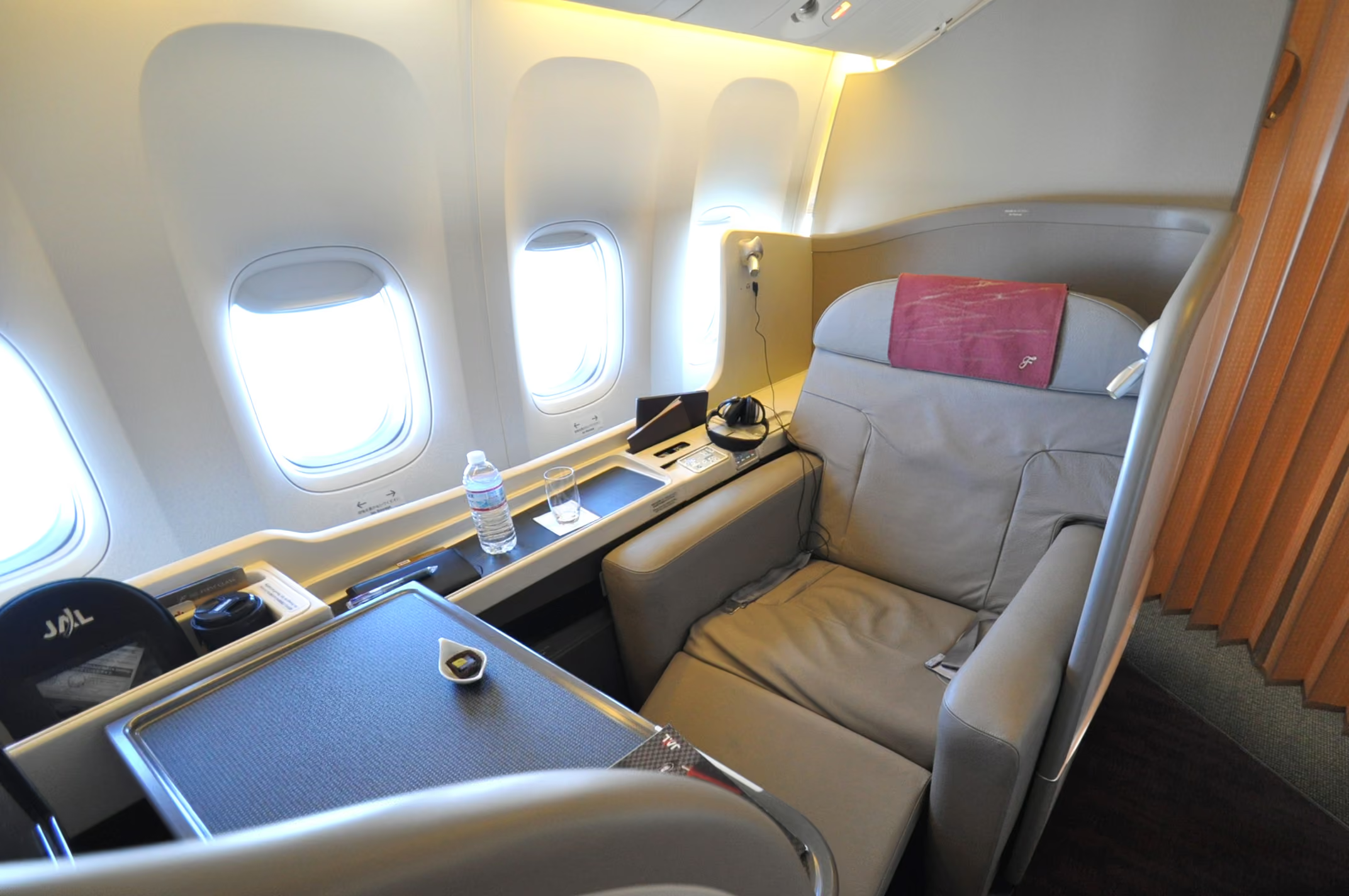
What you get in first class that business class doesn't have comes down to eight concrete differences: a closing-door private suite, a bed longer and wider than any business-class flat bed, a dedicated first-class lounge separate from the business lounge, à la carte dining rather than a set menu, a crew-to-passenger ratio as low as 7:1, a turn-down service, a significantly superior amenity kit, and on Emirates and Etihad, a chauffeur transfer included in the fare. Business class has closed the gap over the past decade, lie-flat beds, direct aisle access and plated meals are standard on long-haul routes with British Airways, Qatar Airways and Singapore Airlines. On the routes where first class still exists, the tangible extras are specific and measurable.
Is there a big difference between first class and business class?: What You Get In First Class That Business Class Doesn't Have
Yes, and on the routes where first class still flies, the gap is substantial. Business class gives you a flat bed, direct aisle access and decent food. What you get in first class that business class doesn't have starts with a closing door and ends with a staff-to-passenger ratio that is difficult to replicate anywhere else in commercial aviation.
The most tangible difference is the suite itself. On British Airways First aboard a 777, the seat reclines to a fully flat 78-inch bed inside a semi-enclosed shell. Emirates First Class on the A380 goes further: a floor-to-ceiling sliding door, a separate minibar, a virtual window for centre-suite passengers, and onboard shower access, two showers shared between fourteen passengers, compared with no shower access at all in business. Qatar Airways Qsuites, widely regarded as the best business-class product currently flying, remains precisely that: business class. The suite door closes, but the product sits in a cabin of 24 to 48 passengers rather than the eight or twelve typical of a first-class cabin. That ratio matters more than most passengers expect.
Bed width is where the comparison gets concrete. Qatar Airways publishes its cabin dimensions openly: Qsuites beds run to roughly 25 inches wide. Emirates First Class beds measure 22 inches wide but are 79 inches long and sit inside a fully enclosed pod. On British Airways, the First seat converts to an 80-inch flat bed, several inches longer than the Club Suite in business. The numbers are close on paper. The context, eight fellow passengers versus 48, is not.
Dining is the second major divergence. Business class on most carriers operates a dine-on-demand model with plated meals and a reasonable wine selection. First class typically adds an à la carte menu with no fixed service window, a dedicated chef on some carriers, and wines at a different tier entirely. Emirates First lists Moët vintage Champagne on its Dubai routes where the equivalent in business is a non-vintage pour. Amenity kits follow the same logic: business class across most carriers now offers a respectable pouch with skincare from a recognisable brand; first class on Singapore Airlines includes Lalique products and pyjamas with a higher thread count than most mid-range hotels.
The honest caveat is that first class is disappearing on many routes. Air France and Lufthansa have removed dedicated first-class cabins on several configurations in favour of premium business products. For UK travellers flying long-haul, first class currently exists in a consistent form on Emirates (Heathrow to Dubai and beyond), British Airways (selected 777 routes), Singapore Airlines (Heathrow to Singapore on the A380) and Cathay Pacific. On those specific aircraft and routes, what you get in first class that business class doesn't have is meaningful. On carriers that have consolidated into a single premium cabin, the comparison is irrelevant.
What perks do you get in flying first class that business class can't match?
First class delivers a private suite with a closing door, a dedicated check-in terminal, à la carte dining on real crockery, a higher crew-to-passenger ratio, a superior lounge, a longer and wider flat bed, a turn-down service, and an amenity kit several tiers above the business-class equivalent. The cumulative effect across a 13-hour flight is considerably more than any single perk suggests.
The suite and the bed
On Emirates A380 first class, each of the 14 suites has a floor-to-ceiling sliding door, a separate seat and a fold-out bed that measures 6 ft 10 in, longer than most people are tall. The bed is made up with a mattress topper, a duvet and a proper pillow while you wait in the lounge or at the bar. British Airways First on a Boeing 777 does not offer a closing door, but the seat pitch runs to roughly 79 inches, and the seat converts to a fully flat 6 ft 6 in bed with a day-bed configuration that business class does not replicate.
Singapore Airlines Suites on the A380 go further still: the mattress is 35 inches wide, broader than many single beds on the ground, and passengers can request a full double configuration by combining two suites. That product is categorically unavailable in business class on any aircraft currently flying the Heathrow to Singapore route. Etihad's The Residence, technically a three-room apartment aboard the A380, includes a separate living room, double bedroom and private bathroom, and ran to approximately £14,000 one-way on the Abu Dhabi to Heathrow sector before Etihad retired the A380 from that route. The point is not the price: it is that the hardware ceiling in the first-class tier has no equivalent in any business cabin.
Check-in, ground experience and what you get in first class lounges that business class doesn't have
The lounge divide is sharper than most people expect. British Airways First customers at Heathrow Terminal 5 access the Concorde Room, a separate reservation-only space with table-service dining, a Champagne bar and a dedicated spa treatment (one 15-minute treatment per customer, bookable from inside the lounge). Business-class passengers use the Club Lounge, which is comfortable but open to the full Club Europe and Club World population travelling that day. On a busy August morning that can mean a 20-minute wait for a table at the Galleries Club.
Emirates keeps a similar separation at Dubai International: first-class passengers use a dedicated terminal with chauffeur arrival, private immigration lanes and a lounge with a pool and spa, while business-class passengers use a different, larger lounge on a different floor entirely. That distinction, an entirely separate building with its own check-in, immigration lane and car transfer from the aircraft steps, is something no business-class product, however polished, currently replicates.
Cathay Pacific's The Wing First Class lounge at Hong Kong International occupies its own section of the terminal and includes a haven area with day beds, private shower suites and a noodle bar staffed during peak hours. The Wing First serves fewer than 50 seats' worth of passengers; The Bridge, Cathay's business lounge, handles the full business-class load on a given departure bank. The difference in square footage per person is significant.
Dining: à la carte versus set menus
Business class almost universally serves a set menu with three or four choices per course, plated in the galley. First class on Emirates, Singapore Airlines and Cathay Pacific operates a Dine on Demand service: you order what you want, when you want it, prepared to order rather than batch-heated. Cathay Pacific First on the A350 carries a dedicated chef on selected Hong Kong routes whose sole responsibility is the first-class cabin, a crew member whose equivalent does not appear behind a business-class curtain.
The crockery is Robert Welch on British Airways First, with Wedgwood glassware; business class uses branded but lighter tableware. Wine lists diverge significantly: BA First carries Dom Pérignon as standard, while the business-class Champagne is typically Lanson or Taittinger depending on route. On Singapore Airlines Suites, the wine list extends to a Book the Cook option where passengers pre-select from a rotating menu of restaurant-quality dishes before the flight, a level of personalisation that does not exist in any current Singapore Airlines business-class product.
Crew ratio and turn-down service
Emirates A380 first class runs 14 passengers to a dedicated crew of two, a ratio of 7:1. The same aircraft's business class has 76 seats and a proportionally thinner crew allocation, closer to 1:12. That ratio translates directly into how quickly a call light is answered and whether your glass is refilled before you notice it is empty, two things that are hard to put a number on but impossible to ignore across a seven-hour overnight sector.
Turn-down service is one of the details that most clearly illustrates what you get in first class that business class doesn't have. On Emirates, Singapore Airlines and Cathay Pacific, a crew member prepares your bed while you dine or visit the bar: the mattress topper is laid, the duvet folded, the pillow positioned and pyjamas left in the suite. In business class, you make up the bed yourself by reclining the seat and pulling a blanket from the overhead locker, or requesting one if it is already full.
Amenity kits and pyjamas
First-class amenity kits are supplied by brands that do not appear in business class at all. Cathay Pacific First uses Bamford; Emirates First uses Bulgari. Business-class kits on the same airlines use house-branded or mid-market products. Pyjamas in first class are typically a two-piece cotton or jersey set, often with a branded sleep mask and slippers with a rubber sole; business class on most carriers offers a softer seat liner or a lighter single-piece suit with foam-sole slippers.
The British Airways travel classes page confirms First customers receive a mattress pad and pyjamas not offered in Club World. On Singapore Airlines Suites, the pyjamas are Lalique-branded and stored in the suite wardrobe alongside a full-length hanging space for jackets, a detail that matters on a 13-hour flight where arriving in the clothes you departed in is the less comfortable option.
Why not wear jeans on a plane?
Jeans are not prohibited on any commercial flight, and no airline dress code bans denim in first class. The reason experienced long-haul travellers avoid them is entirely practical, particularly in a premium cabin where the intent is to change into pyjamas and sleep flat for the majority of the sector.
Denim is a rigid fabric with very little stretch or give. Across an 11-hour overnight flight in a first-class suite, where you move between an upright dining position and a fully flat sleep position, stiff trousers restrict movement in a way that softer fabrics do not. The waistband of a standard pair of jeans does not accommodate the positional changes a flat bed requires in the same way that jersey, cotton or technical travel trousers do, and on a suite product with a closing door, no one is watching what you change into anyway.
There is also a temperature consideration specific to premium cabins. First-class cabins on carriers such as Emirates and Singapore Airlines are kept cooler than economy to suit passengers sleeping flat under duvets. Denim retains warmth poorly compared with the merino or fleece-lined travel trousers that frequent flyers tend to prefer on overnight sectors. The airlines provide pyjamas in first class precisely because the intent is that passengers change into them, so arriving in anything elaborate is, practically speaking, redundant from the moment you board.
Dress-code enforcement in premium cabins is rare and carrier-specific. Most major airlines, including BA, Emirates and Cathay Pacific, do not publish a formal dress code beyond broad standards of neatness. A pair of slim technical trousers in a neutral colour covers both the cabin's temperature range and any lounge environment at either end: the Concorde Room at T5, for instance, operates a smart-casual expectation without a written rule to that effect.
Is first class worth it over business class?
For most UK travellers on most routes, business class is the rational choice. First class earns its premium on journeys of eleven hours or more, when a private suite with a closing door, a genuinely wider bed and a dedicated lounge at both ends amount to a meaningfully different experience rather than a marginal upgrade.
The price gap is the first thing to confront. A return British Airways First ticket from London Heathrow to Dubai typically costs £4,000 to £6,500 depending on season, against roughly £2,200 to £3,500 for Club Suite business class on the same route. Emirates First on the same sector runs from around £5,000 return, and Singapore Airlines Suites to Singapore can exceed £8,000. That differential buys a suite with a door that closes, a bed typically 80 inches or longer (against 72 to 76 inches in most long-haul business class), and on Emirates First, a private shower at 40,000 feet.
On flights under eight hours, the maths rarely works in first class's favour. A London to Cairo sector runs around six hours, not long enough to fully use a turn-down service, a dedicated chef or a spa lounge at the other end. London to Tokyo at nearly twelve hours is a different calculation: every one of those extras has time to be used at least once, and the crew ratio of 7:1 has concrete value on a sector where you are expected to sleep, eat twice and work in between.
If you are spending points rather than cash, the calculus shifts sharply. Redeeming Avios or Miles & More for first class on partner carriers frequently costs less than 50 per cent more than a business-class redemption for a product that, on Emirates or Singapore Airlines, is categorically different. The Which? travel credit card guide outlines which UK cards accumulate Avios most efficiently, relevant if first class via points is the target rather than a cash purchase. Avios redemptions for BA First on the Heathrow to Singapore route currently price at 85,000 Avios one-way against 70,000 for Club World: a 21 per cent points premium for a categorically different product.
Several airlines have retired first class on their Boeing 777-200 fleets in favour of dense business-class configurations, meaning the label can, on some older aircraft, describe a wider seat rather than a genuinely private space. Checking the specific aircraft and seat map on a tool such as SeatGuru before booking takes two minutes and removes the risk of paying a first-class fare for a product that no longer matches the description. Always confirm whether the route operates on an A380 or a 777 before committing, the cabin hardware difference between the two is more significant than the airline branding on the ticket.
What you get in first class that business class doesn't have is real, specific and worth paying for on the right route, the right carrier and the right aircraft type. On a Heathrow to Singapore overnight sector in a Singapore Airlines Suite, the bed is 35 inches wide, the crew knows your name before you board, and the sommelier has pulled the wine you pre-selected before departure, none of which is available in any business-class cabin currently flying the same route.